Key takeaways
- A brow ridge implant (also called a supraorbital or brow bone implant) adds projection to the bony ridge above the eyes. Custom PEEK implants designed from your CT scan are the standard for this area.
- Across eight of Dr. Cömert's supraorbital designs, the implants were typically around 4 to 6.5 mm at their thickest point, feathering to under 1 mm at the edges, about 4 cm long, with almost the whole underside resting on bone.
- The design is built around the supraorbital nerve and stays off the frontal sinus and the roof of the eye socket.
- Brow implants combine well with infraorbital, jaw angle and chin implants and with double jaw surgery; brow implants can go in first.
What a Brow Ridge Implant Is
Brow ridge implants, supraorbital implants, supraorbital rim implants and brow bone implants are four names for the same thing: an implant fixed to the bony ridge that runs above each eye socket. Surgeons use the anatomical term, supraorbital, meaning above the orbit. Patients usually search for the brow ridge or brow bone.
The ridge matters far more than its size suggests. It sets how deep the eyes look, how much shadow falls on the upper eyelid, and how strong or soft the upper third of the face appears. A few millimetres of bone here changes the whole expression.
This guide explains who brow ridge implants suit, how a custom implant is designed from a CT scan, what the operation and recovery involve, and what the real dimensions of these implants look like, using measurements from Dr. Mehmet Cömert's own design library in Istanbul. For the broader picture of implants across the face, see our guides to custom facial implants and how a patient-specific implant is designed.
Why the Brow Ridge Shapes the Face
A prominent brow ridge is one of the clearest skeletal signals of a masculine upper face. In facial feminization surgery, reducing it is often the single most noticeable change; in masculinization, building it up is one of the most impactful. But brow augmentation is not only about gender. A flat brow can make the eyes look exposed and the upper eyelid look hollow or tired, and an asymmetric brow can make one eye look larger than the other.
Dr. Cömert describes the goal in terms patients recognise: a supraorbital implant can create "more hoodedness and more brow bone ridge", meaning a deeper-set eye with more natural shadow over the upper lid.
Who Is a Candidate
Men who want a stronger upper face
The most common candidate is a man whose brow is flat relative to the rest of his face, often while planning other masculinizing changes. In a masculinization plan, Dr. Cömert notes that "even supraorbital implants could be a really good addition" alongside midface, jaw angle and chin implants, sequenced so each step supports the next.
A flat or hollow upper eyelid area
Some patients are less concerned with the brow itself and more with the upper eyelid: it looks exposed, hollow or tired. Adding projection above can restore shadow and depth. "If you want more for the upper eyelids, supraorbital implants can be done," as he puts it.
Asymmetry
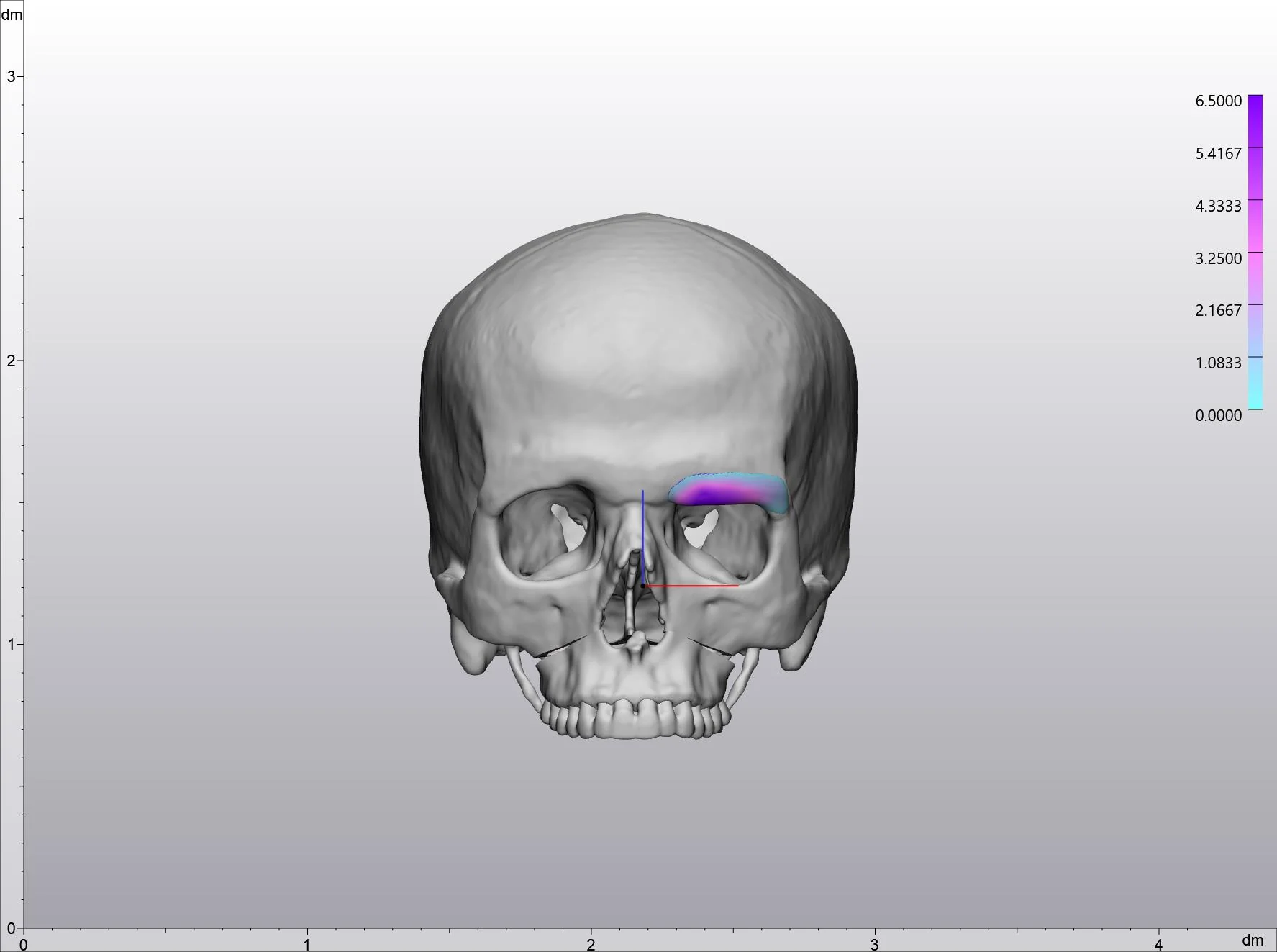
A custom implant can be designed for one side only, to match a flatter brow to its partner. The thickness map shown further down is exactly that: a single-sided design.
Who should wait or choose differently
Before any brow work, the upper eyelids are checked for ptosis (a droopy lid). Some people hide mild ptosis by constantly lifting the centre of the brow; once the brow is corrected, the droop can become more noticeable and may need its own repair. Goals also need to be specific. Dr. Cömert asks for reference photos, because "look better" is, in his words, "a little bit too generalistic" to design an implant around.
Implant, Bone Cement, Filler or Fat: How the Options Compare
| Option | What it does well | Limits |
|---|---|---|
| Custom PEEK implant | Designed to your bone from CT; defined, symmetrical edge; fixed with screws; permanent but removable | Surgery with a scalp or hairline approach; needs planning time before surgery |
| Bone cement (PMMA) shaped in surgery | Can cover large forehead areas | Shaped by hand on the table, so edges and symmetry depend on sculpting; harder to adjust later |
| Filler | No surgery; useful to preview a small change | Spreads and softens rather than creating a bony edge; temporary; the area around the eyes needs care |
| Fat grafting | Natural tissue; can soften hollows | Unpredictable survival; cannot build a defined ridge |
For a defined, lasting brow ridge, a custom implant is the most predictable option, and it is the approach Dr. Cömert uses.
From CT Scan to Custom Implant: How the Design Is Made
Every brow ridge implant Dr. Cömert places is designed for one skull. The process starts with a fine-slice CT scan of your face, which is turned into a 3D model of your bone. The implant is then designed on that model in virtual surgical planning software, reviewed, and manufactured in PEEK, a medical-grade, bone-like polymer widely used for patient-specific facial implants.
What the real designs look like
Most articles about brow implants describe them in general terms. We measured eight supraorbital implants from Dr. Cömert's design library to show what a custom brow implant actually is:
- Shape: a crescent that follows the brow ridge, with its lower edge sitting on the rim of the eye socket.
- Thickness: typically around 4 to 6.5 mm at the thickest point, placed over the rim itself, then feathering to under 1 mm where it blends into the forehead. The average thickness across an implant is only about 2 mm.
- Size: about 4 cm along the brow and under 2 cm high.
- Fit: around 96% of the underside rests directly on bone, which is what makes a custom implant stable and invisible at its edges.
- Symmetry: paired implants are designed as near-mirror images, adjusted to any natural asymmetry of the skull.
These are a small series from one surgeon's practice, not a rule. Your own design is set by your anatomy and your goals.
What the design deliberately avoids
Three structures shape every brow design. The supraorbital nerve leaves the bone through a small notch or opening on the rim and supplies feeling to the forehead and scalp; the design leaves room around that point so the implant does not press on it. The implant stays on the rounded front of the rim and does not extend onto the roof of the eye socket. And the frontal sinus, the air space behind the lower forehead, is mapped on the CT so the design and its screws respect it. The inner ends of Dr. Cömert's brow designs also stop short of the glabella, the area between the eyebrows, which keeps the result looking like a natural ridge rather than a continuous bar.
The Operation
The implant is placed on the bone beneath the periosteum, the tough lining of the bone, a plane that also protects the deeper branch of the supraorbital nerve (Knize, 1995). It is then fixed to bone with small screws so it cannot shift. Screw positions can be refined in the plan, and additional screws are added where needed.
The approach depends on the design. Larger brow and forehead designs, such as a continuous brow bar, go through a coronal incision hidden within the hair behind the hairline, and very large forehead designs may be made in more than one piece so they can pass through the incision. Your surgeon will explain which approach suits your design before surgery.
How long you stay in hospital depends on what is combined. For combined facial implant plans, Dr. Cömert's patients typically stay two nights.
Combining a Brow Implant With Other Procedures
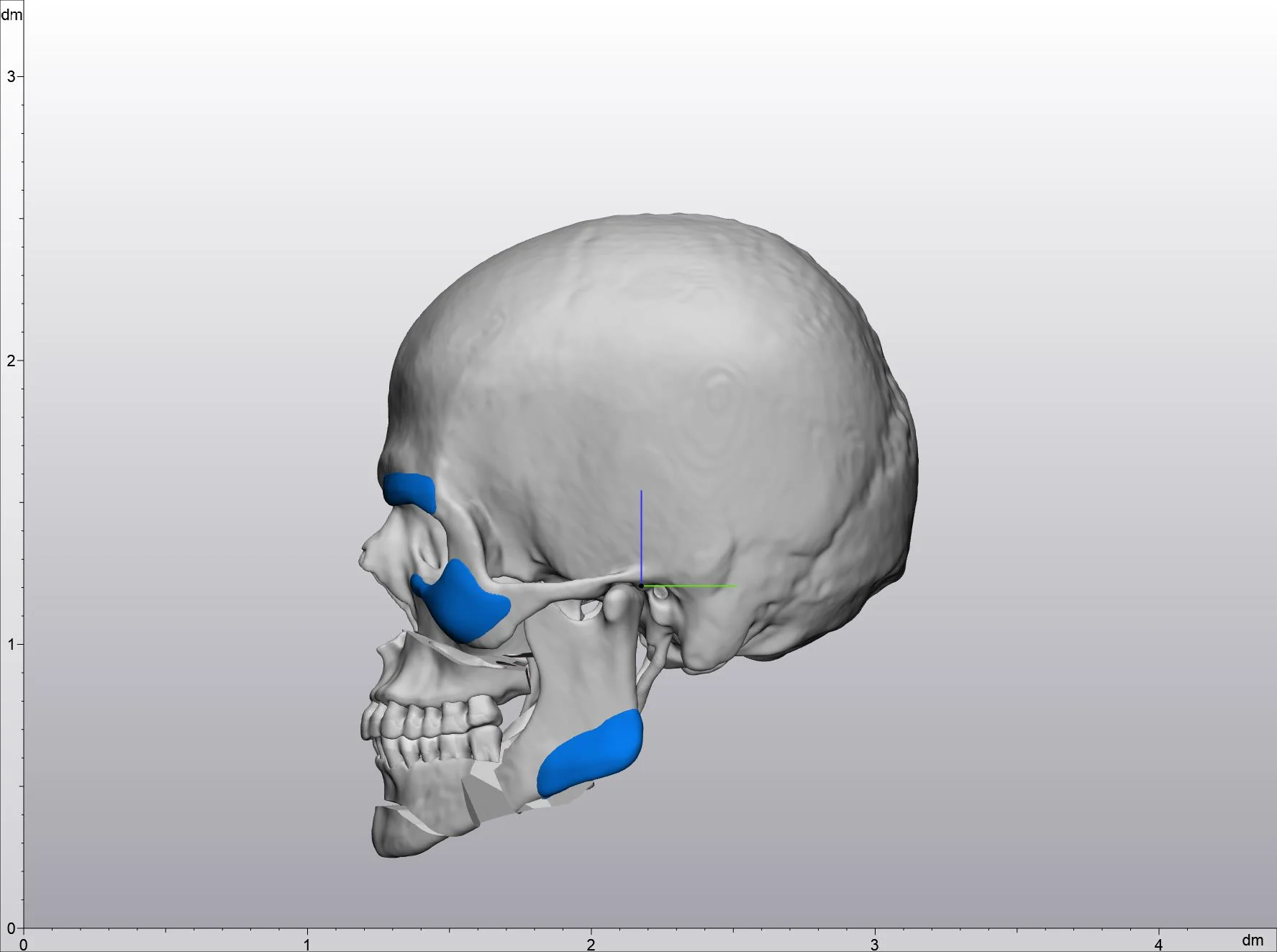
Brow implants rarely travel alone. Common combinations include:
- Infraorbital and midface implants, to frame the eye from above and below. With supraorbital and infraorbital implants together, a canthopexy, a small tightening of the outer corner of the eye, is often recommended to keep the lower lid supported.
- Jaw angle and chin implants, to balance a stronger brow with a stronger lower face.
- Double jaw surgery. Brow implants can be placed before orthognathic surgery, because the upper orbit does not move with the jaws. Implants on the midface, cheeks and jaw angle wait until the jaws are in their final position.
- Rhinoplasty, particularly when the upper bridge of the nose needs to match a new brow line.
Each additional procedure adds to the operation and can lengthen recovery, so the sequence is planned as a whole. Our guide to facial implants for feminization and masculinization covers how these steps fit into a wider plan, and Dr. Cömert's answers on custom facial implants cover implant materials and revisions.
Can a Brow Implant Give You Hunter Eyes?
Partly, and it is worth being precise. A brow implant adds projection and hooding over the upper eyelid, and that shadowed, deep-set look is a large part of what people mean by hunter eyes. What it cannot do is change the tilt of the eye, reliably lower the eyebrows or turn a round eye into an almond one; those depend on the eyelids, the outer corner of the eye and the soft tissue, not only on bone. In the early months after surgery, some patients also notice their brows sitting slightly higher than they expected while swelling settles. The best results come from specific goals, reference photos and a design sized to them.
Recovery
- First days: swelling around the forehead and eyes peaks in the first days. After larger forehead approaches, opening the eyes fully and working at a screen can feel uncomfortable for roughly the first ten days.
- Weeks two to three: sutures or staples are removed and most patients are comfortable in public.
- Months two to three: most visible swelling has settled.
- Months six to twelve: the final contour is judged once the deep swelling has fully resolved.
Temporary numbness of the forehead and scalp is expected after surgery in this area and usually improves steadily as the nerves recover.
Risks and How They Are Minimised
Custom implants have a good safety record. A 2026 meta-analysis of 29 studies on patient-specific facial implants reported pooled rates for PEEK implants of 6.94% for any complication, 1.51% for infection and 0.73% for removal (Steengaard et al., 2026), and a study of 28 PEEK facial onlays found no displacement, exposure or infection (Saponaro et al., 2023). Implants around the eyes need particular care: across all facial implant types, the periorbital region has shown the highest rates of inflammation and removal (Oliver et al., 2019).
The specific risks to discuss are:
- Numbness of the forehead and scalp, usually temporary;
- Infection, uncommon, which may require the implant to be removed and replaced later;
- Visible or palpable edges, minimised by feathering the implant to under 1 mm and by bone-contact design;
- Eyelid changes, including unmasking of a pre-existing ptosis;
- Size or shape that differs from what you expected, which is why the design is reviewed before manufacture. If a revision is ever needed, a custom implant can be removed and replaced with a smaller or reshaped one.
What Affects the Cost of a Brow Ridge Implant in Turkey
There is no meaningful average price for a brow ridge implant, because the operation varies so much: a pair of brow implants or a single continuous brow bar, the incision required, the design and manufacturing of the custom implant, and whatever is combined in the same operation. Dr. Cömert does not quote a price before seeing your anatomy. The assessment and design plan come first, and the cost follows from them.
The Next Step: A Free Online Assessment
If you are considering a brow ridge implant, send front and profile photographs, any reference photos of the look you want, and a short medical history through the free online assessment. Dr. Cömert reviews every case personally and replies within 1 to 3 days with what he would recommend: a brow implant alone, a combined plan, or, where the brow is not the real issue, what would help more. If you go ahead, the next step is a CT scan and a custom design built around your own skull.
Written and medically reviewed by Op. Dr. Mehmet Cömert, plastic, reconstructive and aesthetic surgeon (FEBOPRAS), Istanbul. Last reviewed 22 September 2026. This article is general information and does not replace a personal medical assessment.