Patients asking about custom, patient-specific facial implants arrive with the same questions: chin implant or genioplasty, PEEK or silicone, custom or off-the-shelf, and what can be done about an implant placed elsewhere that never looked right. The answers below are Op. Dr. Mehmet Cömert's own, taken from the assessment voice notes and messages he sends to patients every week, anonymized and edited only for readability.
Dr. Cömert is a European Board certified plastic, reconstructive and aesthetic surgeon (FEBOPRAS) who has practised since 2009 and performed more than 2,400 operations. He plans facial implants on a CT scan, designs them with a dedicated implant designer, and combines them with jaw surgery, deep plane facelifts and fat grafting when a face calls for it. Every case here is a pattern, not a person, and every face is decided individually.
Key takeaways
- Custom implants are designed on your own CT and approved by you before production; off-the-shelf pieces are used depending on the shape you want, or when you are in a rush.
- Genioplasty is his first choice for the chin: it advances the floor of the mouth, and a big prosthesis can make you lose a little bone around the chin in the long run.
- PEEK or Medpor for the bony midface, custom PEEK for jaw angles, silicone for the tear trough alone; PEEK is MRI compatible.
- Oversized, pointy jaw angle implants commonly cause masseter dehiscence; revision means downsizing, muscle repair and a bone-mimicking redesign.
- Every implant plan needs the CT scan itself, proper photos and prior records; lifts, fat grafting and jaw surgery are combined case by case.
Custom facial implants vs off-the-shelf implants: how do you decide which my face needs?
Let me start with my preference: I do like to do facial implants custom made when possible. A custom implant is designed on your own CT scan, so it follows your existing bone structure rather than a shape out of the box. For malar and infraorbital work I prefer custom; for the chin and the jaw angles, custom or off-the-shelf can both be used, depending on the shape you want.
The decision becomes clear when the anatomy is not standard. A patient in his forties who had a genioplasty and jaw surgery before wanted better chin projection: his chin needed a little bit of vertical height, and I did not think any chin implant out of the box would fit and create the result he wanted. The same applies to previously operated bone or an asymmetry to correct: implant surgery is the best way to create symmetry, and when we have the CT scan we make the design according to your existing bone structure.
I do prefer custom, but if you are in a rush, because custom implants take time to produce, then we could go ahead and use Medpor.
The designer matters less than people think; what matters is clear communication, a design that is properly approved before production, and predictable execution in surgery. Which route your face needs is decided on the CT, case by case; you can read how I plan custom facial implants on the service page.
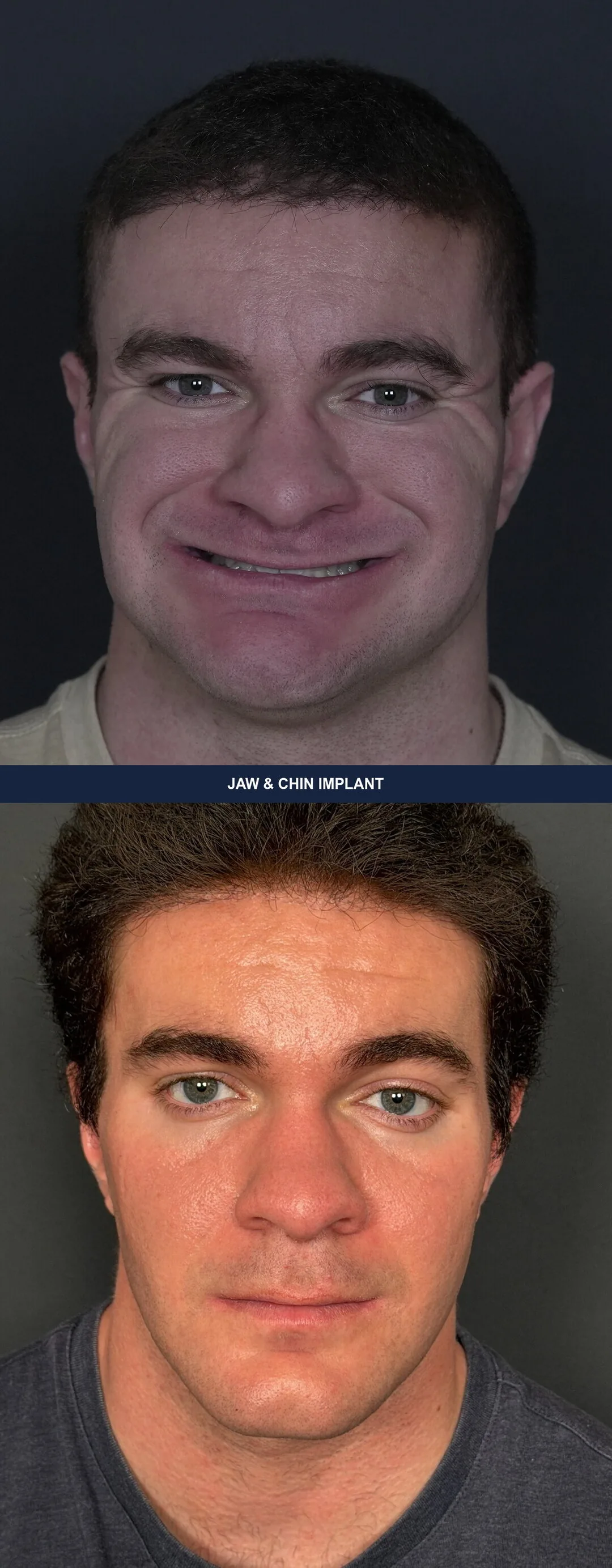
Chin implant vs genioplasty: which do you choose, and what is the bone resorption argument?
There are two ways to bring a chin forward: a chin implant, or an osteo-genioplasty, sliding your own bone forward. I go for the genioplasty whenever there is a chance for it. It does more than project the chin: it advances the tissues of the floor of the mouth, so it improves the double-chin area and the neck, and it can improve breathing and sleep quality. A chin implant does not really have that effect.
Then the bone argument. With a chin implant we cannot have a major improvement, because if you use a big prosthesis, in the long run it can make you lose a little bit of the bony tissue around your chin, and that is not what we want. Patients are generally not very happy with chin implants, especially female patients; a small genioplasty generally gives a better result.
My preferred method would be genioplasty, which also improves the muscle imbalance in your neck and can improve your sleep quality and breathing.
A chin implant still has its place: with a deep plane lift, when someone wants more chin projection and not only the smoother jawline the lift already gives; when someone wants something faster; or when a previously operated chin needs a little vertical height, in which case the implant has to be custom made. The reverse is possible too: a silicone chin implant can be removed and the bone advanced with a genioplasty. Chin implant, genioplasty or full jaw surgery is decided on your CT scan, every face individually.
How is a patient-specific implant designed from my CT scan, and what do you check before it is produced?
The flow is the same for every custom case. First I need your CT scan: the scan itself, not the radiology report, and not a cephalometric x-ray. The consultant can send you exactly how we want the CT taken, and if you come to Istanbul for a consultation we can take you to a partner clinic and have it done here.
Then we run the design with our implant designer, for facial implants, for orthognathic surgery, or both. This is a real conversation: in the design consultation you can give detailed input, even millimetre-level changes, and nothing is produced until you have confirmed the design. Production lead time is confirmed before we schedule surgery, because custom implants take time to produce.
We run a CT scan, we run a design for your case, then we produce those implants according to the design, with your confirmation of course, and then we come up with the treatment plan.
What I check in the design is mostly restraint. Width is not only bone: masseter muscle, skin thickness and body weight all contribute, and trying to create too much width with implants can lead to an unnatural result or visible implant edges. Big, pointy jaw angle implants are a common cause of masseter problems, so I keep designs smaller and bone-mimicking, adding width without unnecessary extension. I do not execute self-designed plans sent in by patients; the design is made on your CT, with you. More on the process is in my article on patient-specific facial implants.
PEEK implant, silicone, Medpor or titanium: which facial implant materials do you use, and how are they placed?
Material follows the job. For the midface I go with bony-type implants, PEEK or Medpor; when we design from a CT the custom implant is PEEK, and the jaw angle implants we design are patient-specific PEEK as well. Silicone I keep for one job: the tear trough alone, placed through the inside of the lower eyelid. Once the plan is tear trough plus midface, custom is the best approach, because the infraorbital rim implant can be extended through the tear trough as one integrated piece. Medpor is my fallback for someone in a rush, because custom implants take time to produce.
PEEK has a practical advantage after surgery as well: it is a non-metallic polymer that is MRI compatible, so if I ever need to look at the soft tissue around an implant, the scan shows it clearly, without the artefact metal creates. In my imaging requests I note that the implant is patient-specific PEEK and that titanium fixation screws, if present, give only a minor artefact.
For the midface I like to use more bony-type implants, which are PEEK or Medpor.
On placement: jaw angle implants go in through the mouth, in the plane under the masseter. A chin implant can also be placed intraorally, but that carries more risk of infection, so I prefer the approach from outside; for men there is no visible scarring there, they heal really well around that area.
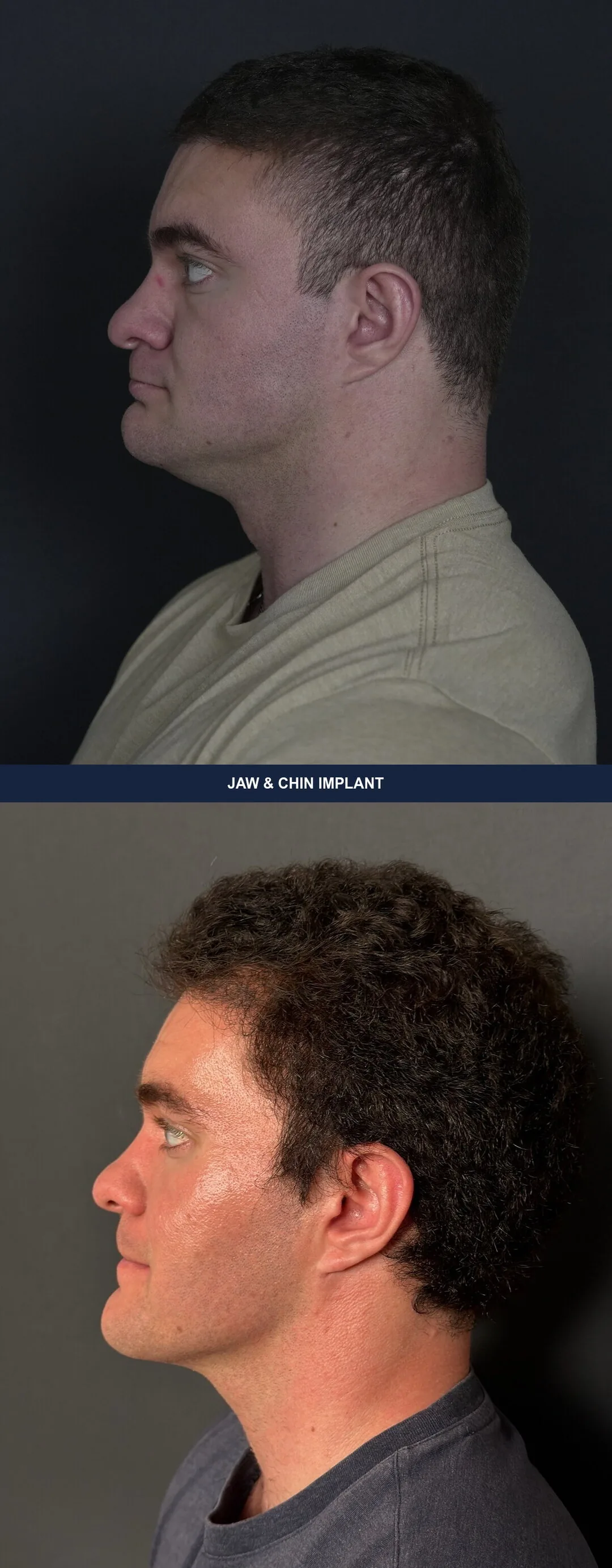
Jaw angle implants, cheek implants and infraorbital implants: what does each change, and who asks for them?
Start with the lower face. When the chin is slightly under-projected and the mandible is small compared to the cheekbones, bilateral angle implants enhance the mandibular border and create more width for the jaw: a smoother, more masculine jawline. A wraparound implant, running from angle to chin and back, also gives a square chin base. Who asks? Mostly men who want definition, but also younger women with a weak jawline, where implants create more structure than a neck lift alone. One caveat: a man's jawline cannot be shaped by implants alone; with fullness under the chin, deep neck work is part of the plan, and thick soft tissue moderates what any implant can show.
In the midface, malar implants give cheek projection; for a masculine look that is what I prefer, and I usually do not add a tear trough implant for men. The infraorbital rim implant is different: it improves the lower lid to cheek junction, and when under-eye darkness comes from bone volume loss, which can be genetic, an implant is the more permanent way to support it. One integrated design can extend through the tear trough, so you do not need two implants.
They can be done in a small, subtle way; they absolutely do not have to be exaggerated.
A full midface mask can even mimic some of the visual benefit of a skeletal advancement without an osteotomy done purely for cosmetic reasons. Each region is described on the custom facial implants page.
Supraorbital implants and browridge implants for a more masculine upper face: what do you do and how do you plan it?
Custom-made supraorbital implants are how I build more brow-bone ridge and hoodedness over the eyes, a request I hear from men who want a stronger upper face. Like every custom piece it is designed on the CT with the designer, and I adjust the size to the goals you show me in your wish pictures. Supraorbital implants can go in at the same time as orbital, infraorbital or jaw angle implants, and it is safe to combine them with a canthoplasty.
Forehead and cranial contouring is a bigger undertaking. Custom forehead, supraorbital and cranial implants go in through a coronal incision, and a large piece may need to be divided into several parts to pass through it. There is significant swelling to expect, with temporary difficulty opening the eyes in the early days, and hairline advancement through the same approach can be limited by scalp mobility and the implants themselves.
The supraorbital area can be improved with custom-made supraorbital implants to create even more hoodedness and more brow-bone ridge; this is possible.
What I check before touching the brow is the eyelid. A mild ptosis can be compensated by raising the central brow; once the orbital rim is built up, that ptosis can become more visible and may need a later repair, so I plan for it. In one such case I deliberately postponed the canthopexy until the effect of the implants and the lift could be judged. For the feminine and masculine directions of this work, see facial implants for feminization and masculinization.
Implant revision: can you fix or replace implants another surgeon placed that are malpositioned, asymmetric, visible or infected?
Yes. A common one is muscle bunching above the jaw angle implants, worse when the patient clenches. Nine-millimetre implants usually cause this, and the pointy type causes it more: it is a masseter dehiscence, a very common consequence of big implants. When the two sides do not match, the jaw angle implants are replaced with a smaller, more bone-mimicking design that corrects the asymmetry; a supraorbital rim implant that interferes with eye opening may need exploration, a smaller implant and a ptosis repair if needed.
Visible edges get the opposite logic: I would rather smooth irregularities or cover an edge with fat grafting than create soft-tissue volume with oversized rigid implants. And I avoid operating again and again through the same central facial tissues, because scarring, capsule formation and lymphatic disturbance add up.
The implants should be reduced and the muscle can be repaired intraorally; that is the approach that I would employ.
An infection changes the timetable. In one case the source was a plate from earlier jaw surgery, not the implants; I wanted it completely resolved and the tissues settled, allowing around four months, and we used that time to prepare new designs on a fresh CT rather than re-placing the removed implants. Old silicone implants, or implants removed elsewhere, do not contradict a new design. For all of this I need your CT scans, implant files and prior records, sometimes with an MRI on arrival to assess the soft tissue around the implants; the treatment plan comes after that.
Can custom implants be combined with a facelift, fat grafting or jaw surgery, and what do you need for an online assessment?
Midface implants and a temple lift go together well, and a canthoplasty lasts longer once the midface is supported. A deep plane face and neck lift is added when the lower face needs re-draping; in a younger face I may not think it necessary yet: implants alone first, see how much improvement you have, and add a lift later.
Fat grafting is a conservative finisher: a subtle bit to contour, smooth irregularities or cover an implant edge; it is unpredictable, retention varies and a second session might be needed. Where the deficiency is in the bone, an implant is the more permanent answer and fat the lighter one; I say which I would pick and leave the choice to you. With orthognathic surgery, plates and implants can be designed in one plan; otherwise midface and jaw implants come after the jaw surgery, not before. Some plans are staged: if we are going to do everything, I do not recommend doing it all at once.
Combining it with an upper and mid-face lift performed from the temple area gives a better result; I think it prevents the soft tissue from sliding down over the implant.
For the online assessment, send photos straight from the front and from each side, same lighting, not overexposed, plus your wish pictures. For any implant plan I need the CT itself, usually a full head to collarbone scan; the consultant sends the specifications, and I add intraoral scans if the bite looks off. Then we start preliminary designs, with or without a deep plane facelift.
The next step
If you are weighing custom implants against a genioplasty, a lift or jaw surgery, I really need to see your photos and, for any implant plan, your CT before I can tell you what I would do. Start with a free online assessment and let me know what you think; every face is decided individually.