Key takeaways
- Every face is a little asymmetric. Facial asymmetry becomes a surgical question when it comes from the skeleton: a chin that points to one side, a jaw that is longer on one side, or a smile and bite that tilt.
- Asymmetry is common in people seeking jaw surgery: in one large clinic survey about a third had visible facial asymmetry, the chin was involved in 74% of them and the bite was tilted in 41%.
- A skeletal tilt of the bite and smile (an occlusal cant) is corrected by levelling the upper jaw, usually together with the lower jaw; implants and fillers cannot level it, and only very mild dental cants respond to orthodontics.
- Because the two sides of the face need different movements, asymmetry is where custom jaw surgery matters most: 3D virtual planning, cutting guides and patient-specific plates.
- Perfect symmetry is not a realistic promise. The goal is a face that reads as balanced, with any small remaining difference treated by contour if needed.
People who come to a consultation about facial asymmetry usually describe it in one of three ways: "my chin is off to one side", "my smile is crooked", or "one side of my jaw is bigger". All three can be soft tissue, skeletal or both, and the treatment depends entirely on which. This guide explains how surgeons tell them apart, when orthognathic (jaw) surgery is the right answer, and how custom, 3D-planned surgery corrects the parts of an asymmetric face that need different movements on each side.
How common is facial asymmetry?
In a retrospective survey of 1,460 patients evaluated at the dentofacial clinic of the University of North Carolina, 34% had clinically apparent facial asymmetry. When it was present, it affected the upper face in only 5%, the midface (mainly the nose) in 36% and the chin in 74%. The bite was tilted, a sign of vertical asymmetry, in 41%. When the chin deviated sideways, it went to the left in about 80% of cases. The lesson for patients is reassuring: asymmetry is a known and well studied part of jaw deformity, not an unusual exception.
What kind of asymmetry do you have?
Chin deviation
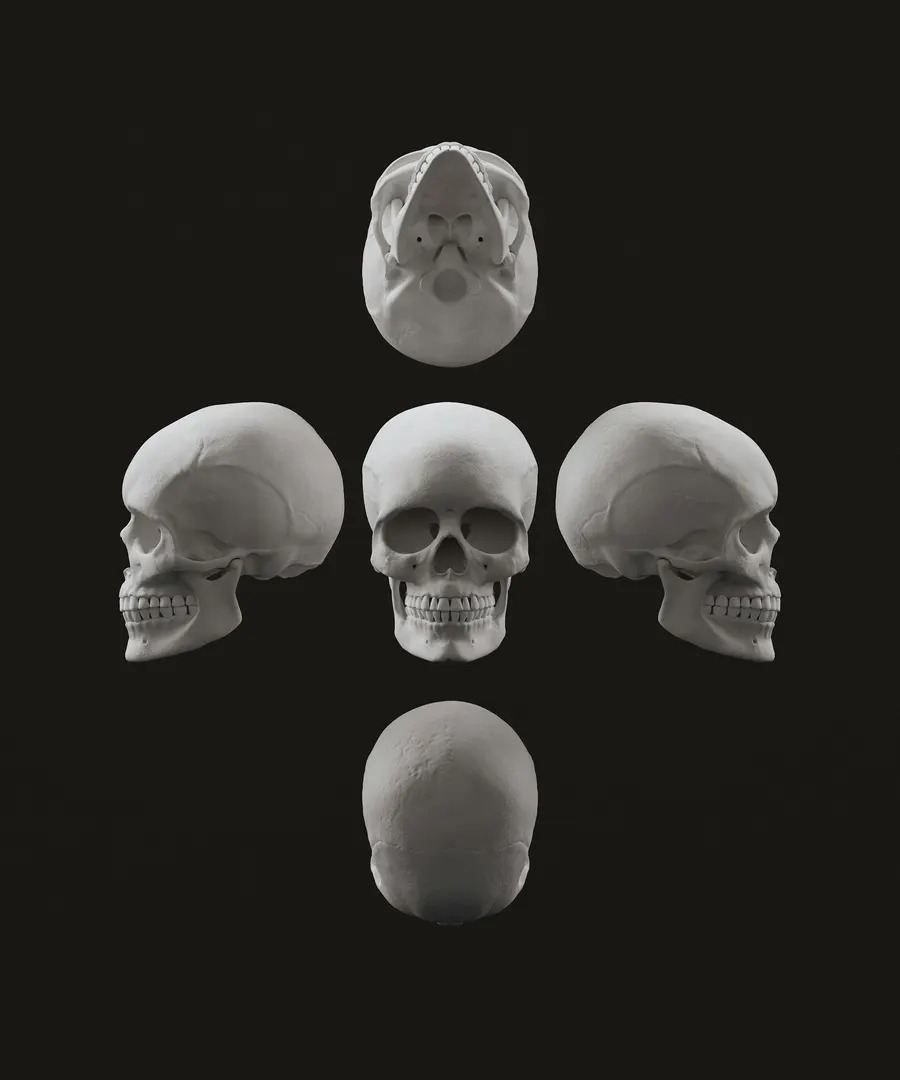
The chin point sits off the facial midline. It may be the chin alone, in which case a genioplasty can recentre it, or the visible end of a lower jaw that is rotated or longer on one side.
Lower jaw asymmetry
One half of the lower jaw is longer, taller or fuller than the other. One cause is uneven growth at the jaw joints. Overgrowth of one condyle beyond the normal growth period is called condylar hyperplasia. Wolford and colleagues separated overactive normal growth, which pushes the jaw mainly forward or to one side, from osteochondroma, which causes mainly vertical overgrowth on one side, and from rarer tumours. Other causes include developmental conditions such as hemifacial microsomia, previous trauma and a functional shift of the bite. The practical point for patients: if a joint is still actively growing, this is assessed with serial records and often a bone scan (SPECT), and active growth is treated, for example with a condylectomy, before or at the time of the jaw correction; otherwise the asymmetry can return.
Upper jaw and the occlusal cant
If one side of the upper jaw is taller than the other, the bite and the smile tilt. You may notice more gum on one side when you smile, or that a pen held between the canines is not level. Dr. Cömert is unequivocal about this pattern. A cant is the situation "where the arc of the dental arch is not symmetric: the only way to correct that is orthognathic surgery." Very mild cants that sit in the teeth rather than in the bone can sometimes be improved with orthodontics.
Midface and soft tissue
Some asymmetry sits in the cheekbones, the nose or the soft tissue: a stronger masseter muscle on the chewing side, uneven fat, or skin differences. As Dr. Cömert often reminds patients, "width is not only bone: masseter muscle, soft tissue, thin skin and low body weight all contribute". These parts are planned differently, sometimes without moving the jaws at all.
When does asymmetry need jaw surgery?
A useful way to think about it is a ladder, from the least to the most invasive option. The right rung is the lowest one that actually treats the cause.
| Where the asymmetry sits | What usually treats it |
|---|---|
| Soft tissue only: muscle, fat, skin | Non-surgical options or soft tissue surgery; no bone movement |
| Contour only, bite level and centred | Patient-specific implants designed to fill the weaker side |
| Chin point off centre, rest of the jaw balanced | Genioplasty, moving the chin bone to the midline |
| Bite tilted (occlusal cant) or upper jaw uneven | Le Fort I osteotomy to level the upper jaw, usually as bimax surgery |
| Lower jaw rotated or longer on one side | Bimaxillary surgery with different movements on each side, often with genioplasty |
| Still-active joint growth | Growth assessed and treated first, then corrective surgery |
For milder cases, Dr. Cömert often prefers to avoid full jaw surgery when the bite is acceptable. A mild Class II bite with no functional issues, in someone who does not want full jaw surgery, "can be treated with genioplasty plus implants designed to address the asymmetry". Our guide to patient-specific facial implants explains how those implants are designed.
What is custom jaw surgery?
In a symmetric face both sides of the jaw move by the same amount. In an asymmetric face they do not: one side may need to come down while the other goes up, the jaw may need to rotate around a vertical axis, and the chin may need to move separately. Surgeons describe these movements in three rotations: pitch (tipping up and down), roll (levelling a tilted bite) and yaw (turning the jaw towards the midline). 3D planning was developed to make these combined movements easier to plan and to transfer, although the evidence for better rotational accuracy is still limited.
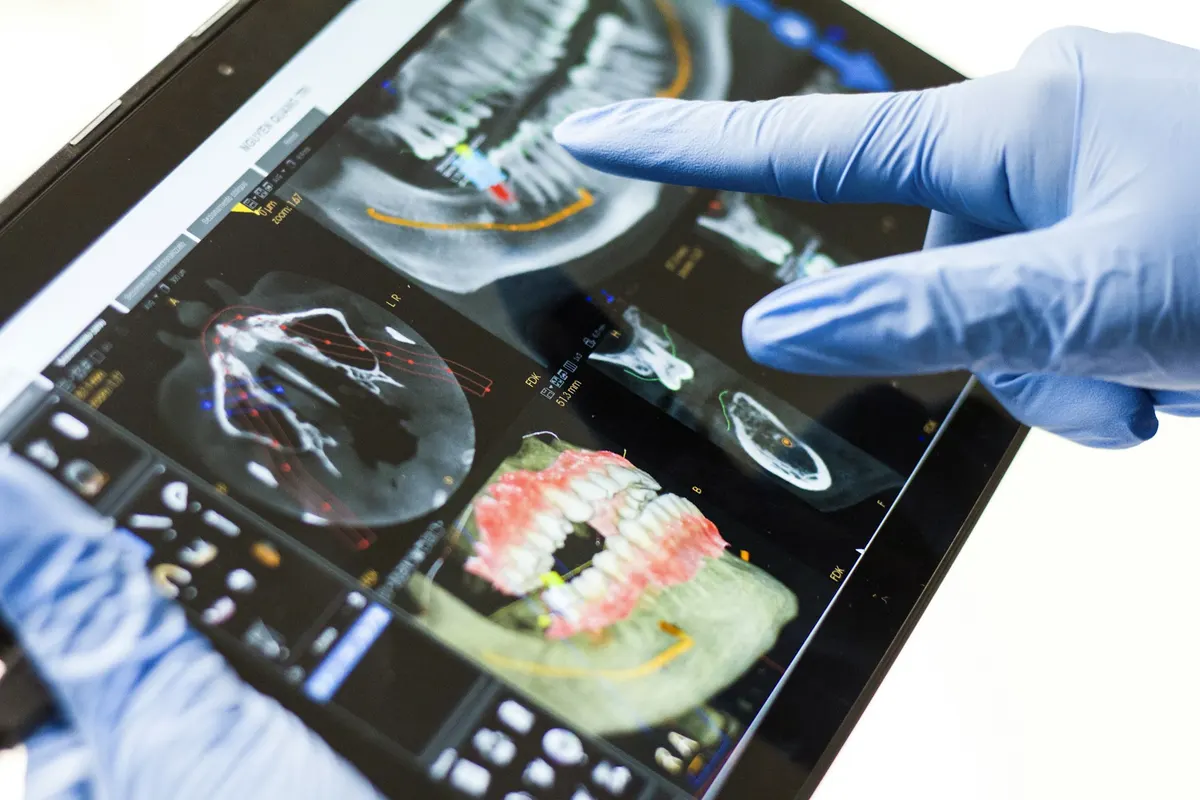
A typical custom workflow has four steps:
- Records: a full CT scan of the face, intraoral scans of the teeth and photographs. Dr. Cömert asks for the CT data itself, and a tooth-only CBCT is not enough to plan a face.
- Virtual surgery: the osteotomies are simulated on your 3D skull, each segment is moved to its planned position and the result is measured in millimetres and degrees.
- Design: cutting guides that sit on your bone and show the surgeon exactly where to cut and drill, and titanium plates shaped to your anatomy whose screw holes match the guide holes.
- Transfer: in surgery, the bone is cut through the guide and fixed with a plate designed to hold the segment in the planned position, which brings the result very close to the plan.
The evidence is encouraging for accuracy. In a prospective study of 22 bimaxillary patients, guides and patient-specific plates placed the upper jaw within a median of 0.39 mm of the plan, with deviations of up to 2 mm in the front-to-back direction. A 2026 systematic review and meta-analysis of 30 studies found smaller positional errors with patient-specific guides and plates than with CAD/CAM splints, with no significant difference in complications; the advantage in rotational accuracy was small and uncertain, and long-term stability and patient-reported outcomes have not yet been compared. Accuracy is also lower for large movements: in one series, it fell for advancements over 10 mm. Correction of asymmetry itself, once considered difficult to hold, is classified as stable when rigid fixation is used, although the dental midlines and chin can still shift sideways by more than 2 mm in about a third of patients, which is one more reason careful planning matters.
"Perfect symmetry is not something I can promise; with custom cutting guides and plates we try to have the most perfect symmetry possible, and implants can be designed to address a remaining asymmetry."
Do you need braces before asymmetry surgery?
Usually some orthodontics is needed. Teeth tend to tilt to compensate for an asymmetric skeleton, which hides part of the problem; removing these compensations lets the surgeon correct the bone fully. Any crossbite or narrow upper jaw is assessed at the same time and may need the upper jaw to be widened, sometimes with a multiple-piece Le Fort I. In selected cases a surgery-first approach is possible, with orthodontics afterwards.
Why perfect symmetry is the wrong goal
Even after a precise skeletal correction, the two halves of a face are never mirror images. Muscles, fat, skin thickness and the way you chew are slightly different on each side, and they remain different after surgery. A face that has been forced into perfect mathematical symmetry can also look artificial. The realistic and better goal is a face whose midline, bite and jawline read as balanced at conversation distance, with any residual contour difference addressed separately and conservatively.
Recovery after asymmetry correction
Recovery is the same as for any double jaw surgery in Istanbul: one to two nights in hospital, swelling that peaks around the third day, home rest for one to two weeks and a staged liquid to soft diet for about six weeks (our soft-food guide helps). Numbness of the lips and chin is normal and fades over weeks to months. International patients typically stay about 10 to 14 days in Istanbul for the first follow-ups, then continue remote check-ins. Bone consolidates and the final balance settles over 6 to 12 months.
Risks to discuss before asymmetry surgery
- Residual asymmetry, usually in the soft tissue, which may need a small secondary refinement.
- Altered sensation of the lower lip and chin after lower jaw surgery, typically temporary.
- Relapse, particularly sideways drift of the chin and dental midlines, and recurrence if joint growth was still active.
- Bite changes during healing that need orthodontic fine tuning.
- Jaw joint changes: asymmetric movements load the two joints differently; joint health is assessed before planning, and joint symptoms or condylar remodelling can occur.
- The general risks of jaw surgery: bleeding, infection and hardware problems, all uncommon.
How to start
Asymmetry is assessed best in three dimensions, but the first step is simple. Send front, profile and smiling photographs, a photo of your bite in full closure from the front and both sides and, if you have it, a full CT scan through the online assessment. Dr. Cömert reviews every jaw case personally and replies with what he sees: soft tissue or skeletal, chin or whole jaw, and whether implants, genioplasty or bimax surgery would treat it. If your jaw also sits back, read our guide to mandibular retrognathia; if snoring or sleep apnea are part of the picture, see jaw surgery for sleep apnea.
Prepared by the practice of Op. Dr. Mehmet Cömert, European Board-certified (FEBOPRAS) plastic, reconstructive and aesthetic surgeon, Istanbul. Quotations are from Dr. Cömert's own patient consultations. Last updated 24 October 2026. This article is general information and does not replace a personal medical assessment.