Why patients trust Dr. Cömert with their neck
- Trained in the deep plane technique at the Mayo Clinic (2023), returning as FaceAcademy 360 guest faculty in 2026
- Author of a peer-reviewed study of submandibular gland reduction in deep-plane neck lift (Plastic and Reconstructive Surgery, 2025; see publications)
- Fellow of the European Board of Plastic, Reconstructive and Aesthetic Surgery (EBOPRAS, 2024)
- 2,400+ operations performed since 2009, for patients from 48 countries
- Holder of the Turkish Ministry of Health International Health Tourism Authorization
What is a neck lift?
A neck lift restores a defined jawline and a smooth angle between the chin and the neck by treating the layers beneath the skin, not just the skin itself. Depending on what causes the fullness or sagging, that can mean tightening the platysma muscle, reducing the deep fat that sits under it and, where they contribute, refining the digastric muscles and the submandibular glands. Dr. Cömert performs it in Istanbul as a deep neck lift, most often together with the lower face.
Why the neck ages in layers
The neck is built in layers, and each one can contribute to the problem: the skin, the fat just under the skin, the platysma muscle, the deep fat beneath the platysma, and deeper still the digastric muscles and the submandibular glands. Loose skin with good muscle tone needs a different operation from heavy deep fat or vertical platysma bands. The anatomy-first guide to neck lift in Turkey explains each layer in detail.
In a deep neck lift, through a short incision in the crease under the chin, the surgeon reduces the deep fat and, where they contribute to the fullness, trims the digastric muscles and partially reduces the submandibular glands. The platysma is then repaired over the top, which is what gives the jawline its definition.
Why liposuction or devices alone rarely fix the neck
Liposuction only reaches the fat above the muscle, and energy-based devices do not reposition anything. Dr. Cömert is direct about it: "I certainly do not recommend any type of liposuction or any type of energy-based devices on the neck." He regularly treats patients who are unhappy after chin liposuction, where the deeper causes of the fullness were never addressed.
Neck lift and facelift: why they usually go together
Dr. Cömert's short version, which he repeats to almost every patient, is that "a good neck lift comes from a good facelift." The jowls, the jawline and the neck sag together, so he usually treats cheeks, jowls and neck within an extended deep plane face and neck lift, releasing the retaining ligaments so the tissues move as one unit. In some neck-only cases the incision can be limited to the area around and behind the earlobe, with no incision in front of the ear. Which of these applies to you is decided at assessment.
Who is a good candidate?
Candidates are healthy adults bothered by a loose or full neck, vertical bands, or a blurred jawline. Age on its own is not the deciding factor; as Dr. Cömert puts it, "We don't treat the age; I treat the face." Before surgery he generally asks patients to be at a BMI of around 26 to 27 or below. Smoking, uncontrolled blood pressure and blood-thinning medication all raise the risk of a haematoma, so they are addressed before a date is set, and men on testosterone are asked to pause it for two to three weeks before surgery.
Recovery, step by step
- Hospital: a two-night stay in a partner hospital in Beşiktaş with a full anaesthesia team.
- Weeks 2–3: most patients feel presentable.
- Compression garment: worn full-time for about four weeks, then at home for about four more.
- 6–12 months: the contour keeps refining, and full sensation can take up to a year to return.
Any aesthetic revision is considered only after the tissues have fully settled, typically nine to twelve months after surgery.
Before and after: neck lift results
Two of Dr. Cömert's patients whose plans included a deep neck lift, photographed before surgery and at follow-up. The profile view is where a neck lift reads most clearly: the angle under the chin and the line of the jaw.
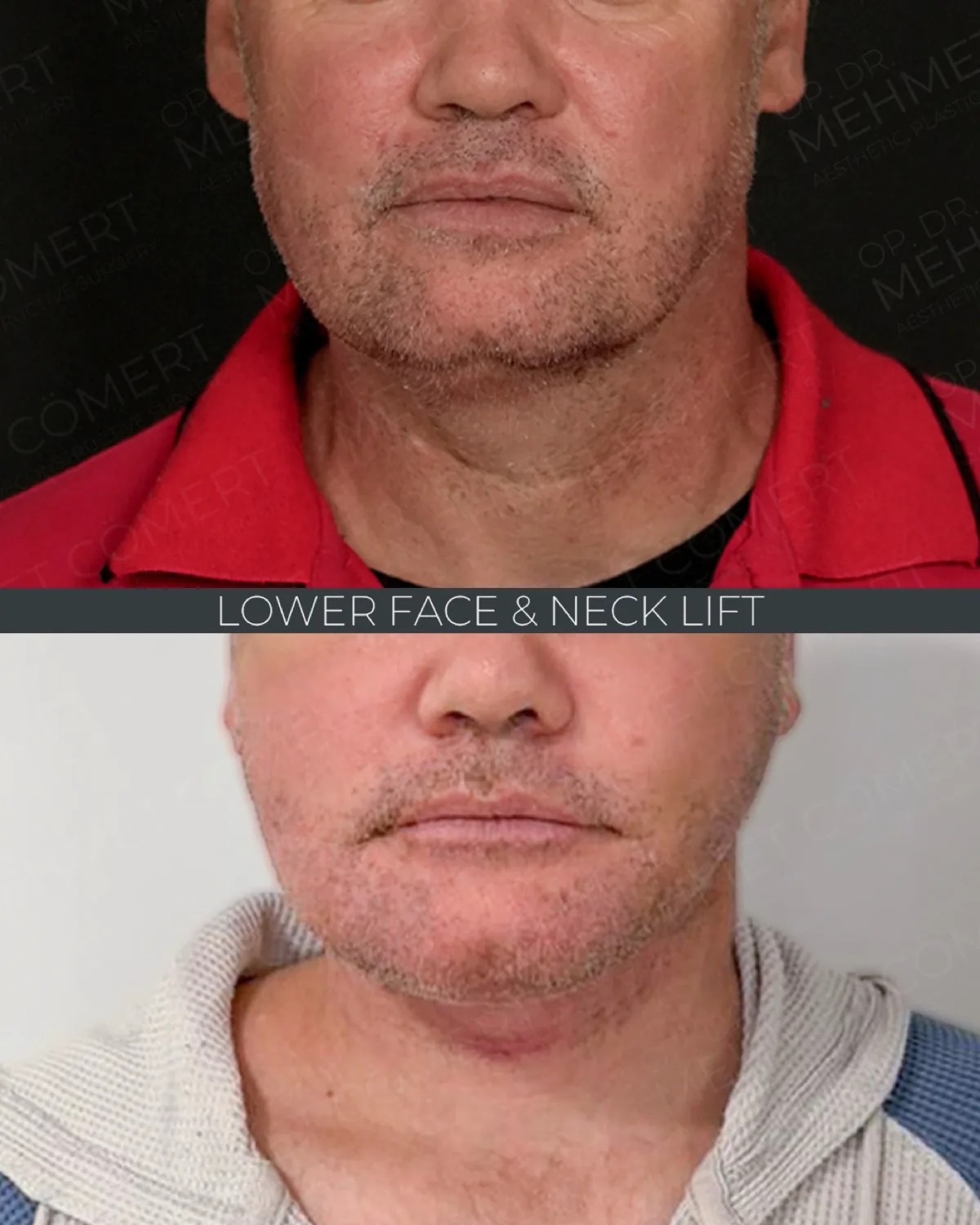
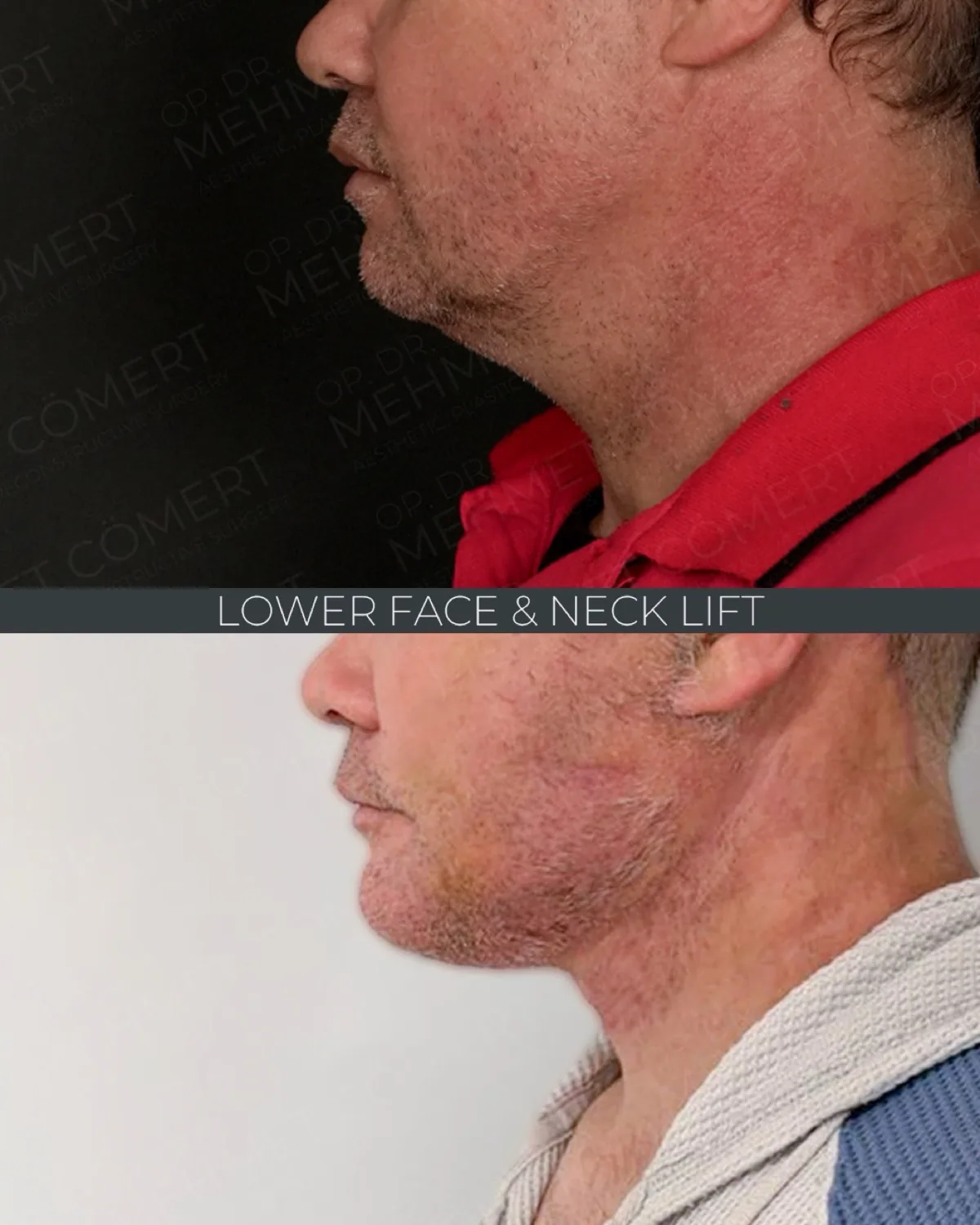
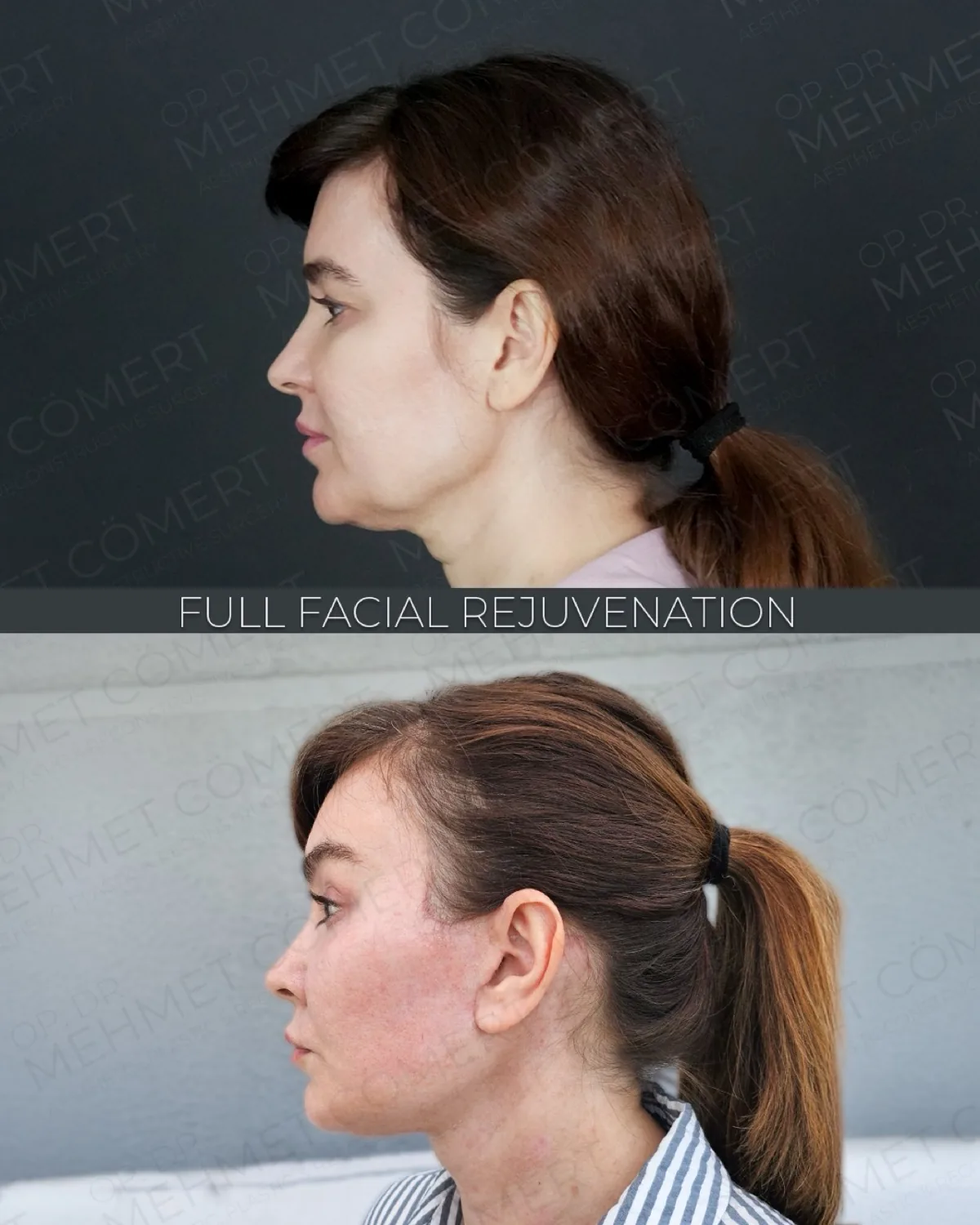
Individual cases shown to illustrate what the operation changes, not as a promise of any particular outcome. The first patient is photographed one month after surgery, before swelling has fully settled. Suitability, technique and recovery vary by individual.
See every photograph from these albums →
Why patients travel to Istanbul, Turkey for this surgery
Dr. Cömert's practice is built for international patients: people from 48 countries have travelled to Istanbul for his surgery. The operation is performed at a partner hospital in Beşiktaş with a full anaesthesia team. Before you book anything, you send photographs and your history through the online assessment; Dr. Cömert reviews every case personally and you receive an answer within 5 to 7 working days, so you know whether you are a candidate before buying a flight.
Once you are in Istanbul, a patient coordinator manages appointments, hospital admission and transfers. How long you stay in Istanbul depends on your individual plan and is confirmed before you travel. After you fly home, follow-up continues remotely with Dr. Cömert's team for as long as you need it. Turkey is one of the world's largest medical travel destinations, and the clinic holds the Turkish Ministry of Health authorization for international health tourism; what sets practices apart is who operates and how follow-up works, which is why this page names the surgeon, the training and the hospital rather than a package.